
The question “why AI coaching now?” used to sound like an invitation to speculate. During my recent podcast conversation with Anke Paulick, it sounded much more like an operational question for HR and L&D leaders who have already lost the luxury of waiting. People are using AI as a thinking partner, writing partner, decision aid, practice companion, and emotional sounding board. The formal L&D program may still be in procurement, but the behavior is already inside the organization.

I talked to Anke Paulick, President of the ICF Germany Chapter, in the Speexx Exchange podcast about AI Coaching Governance. Anke brought the International Coaching Federation perspective into a live professional conversation, and I asked her why this moment feels different after decades of AI research and many years of digital coaching tools. Her answer was direct: AI coaching is not a future scenario. It is already here, already in use, and already shaping how people think about access, scale, quality, and trust in coaching.
That framing changes the buyer conversation. HR and L&D leaders are deciding whether the organization can provide a safer, more methodically grounded, more transparent way for people to use AI for reflection and development. Responsible AI coaching becomes a response to real behavior rather than a speculative innovation project.
AI usage has moved into the human layer of work
Anke opened the “why now” part of our conversation with current AI usage research from Marc Zao-Sanders and Sara Biuk. Their 2026 Harvard Business Review article, How People Are Really Using AI in 2026, reports on 12,637 AI use cases drawn from a database of nearly 50,000 records collected between March 2025 and February 2026. The work comes through AI in the Wild, which focuses on how people actually use AI rather than how vendors present it.
The data has one implication that L&D cannot avoid. AI is no longer confined to coding, content generation, or automation. People are using it for personal and professional support, including thinking, preparation, decision-making, relationship advice, and companionship. The HBR summary notes growing anxiety about “thinkslop,” a term for cases where people hand over too much cognitive responsibility to AI. That is not a reason to reject AI coaching. It is a reason to design coaching systems that preserve reflection rather than replacing it.
In the podcast, Anke treated this as a coaching quality issue. If people already use general AI tools to think through work and life, the coaching profession has to define how AI coaching differs from open-ended chat. The distinction is subtle in the interface and substantial in the design. A coaching system asks better questions, holds boundaries, supports client accountability, respects values, and knows when the topic has left coaching.
For enterprise buyers, the practical problem is that users rarely separate these categories neatly. An employee who wants help preparing for a difficult conversation may start with a public AI tool. A manager who wants to think through a team conflict may treat the tool like a coach. A graduate in a global talent program may ask for role-play support before speaking with a senior stakeholder. The behavior looks like learning, but it may involve sensitive data, managerial risk, cultural nuance, and emotional pressure.

Explore the real use cases of the technology behind responsible AI coaching - with Egle Vinauskaite and Donald Taylor.
The access argument is real, but it cannot carry the whole business case
AI coaching attracts buyers because it promises scale. That promise is not superficial. Human coaching is valuable, but it is expensive and scarce. Many organizations reserve it for senior leaders, high potentials, or moments of specific need. AI creates a new access model for people who rarely receive coaching support: first-time managers, project leads, specialists moving into leadership, international teams, employees preparing for feedback conversations, and people who need a private space to rehearse before they speak.
The Terblanche research Anke referenced shows why this access argument cannot be dismissed. In the 2022 comparison of human and AI coaching for goal attainment, both human coaching and AI coaching outperformed control groups, with the AI coach proving as effective as human coaches at the end of the trials in that defined context. A separate Coach Vici randomized controlled trial followed an experimental group using Vici for six months and collected eight measurements across goal attainment, resilience, psychological wellbeing, and perceived stress. The experimental group showed a statistically significant increase in goal attainment, while other measures were not significant.
Those findings are useful because they are precise. They do not prove that AI can replace human coaching. They do show that structured, goal-focused AI coaching can contribute to goal progress under certain conditions. For HR and L&D leaders, that nuance is exactly where the business case becomes credible. AI coaching is strongest when it expands access to focused reflection, preparation, and practice. Human coaching remains essential where complexity, emotion, stakeholder dynamics, identity, values, or risk demand human judgment.
The budget question then becomes more mature. Buyers are looking beyond lower cost. They are looking for more coaching cases for the same budget, better continuity between human sessions, broader access for populations previously excluded from coaching, and personalization without losing governance. That is a stronger buyer expectation than “do it cheaper.”
The ICF framework gives structure to a market moving faster than policy
Anke’s ICF perspective is helpful because it did not ask buyers to choose between enthusiasm and caution. The ICF AI Coaching Framework divides the work into six domains: Foundation, Co-Creating, Communicating, Cultivating, Assurance and Testing, and Technical Factors. Four domains connect directly to coaching logic. Two address AI-specific governance, including validation, bias monitoring, privacy, security, resilience, and accessibility.
This structure matters because it keeps the conversation from collapsing into interface quality. A demo can show whether the AI sounds fluent. It cannot show whether the underlying system has a tested distress protocol, whether the prompts are grounded in coaching methodology, whether user data remains private, whether bias testing includes diverse users, or whether the provider has a named accountability model. The ICF framework pushes buyers toward evidence.
The ICF practical guide to integrating AI and coaching extends the same logic. It treats AI coaching as an entire system rather than a conversation box. That view is essential for enterprise L&D because implementation involves IT, procurement, legal, data protection, works councils, HR business partners, managers, and the employees who will decide whether the tool feels safe enough to use honestly.
Donald H. Taylor’s Global Sentiment Survey 2026 provides a useful backdrop here. The report describes a high-pressure environment for L&D and says AI is increasing stress rather than relieving it. That connects directly to Anke’s point. AI adoption is not automatically easing the work of L&D teams. In some cases, it adds new uncertainty about quality, capability, evidence, and governance.
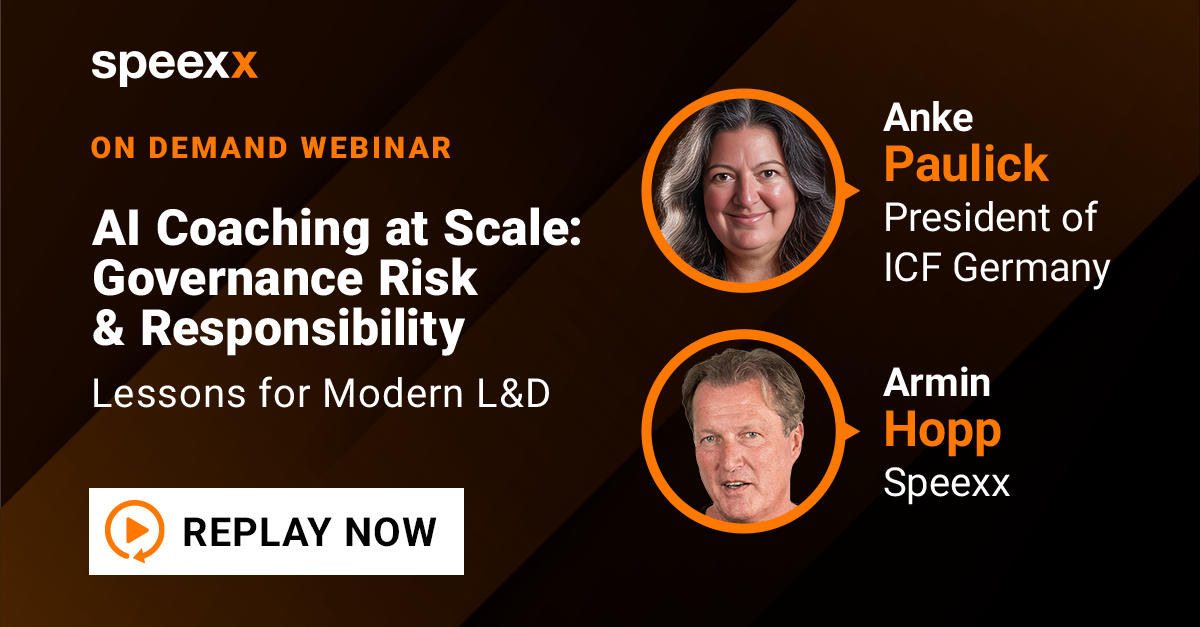
View and listen to the full conversation with ICF Germany President Anke Paulick on responsible coaching and why now is the time for AI Coaching.
Personalization needs boundaries to become development
Personalization is attractive because users can feel it immediately. A coaching system that adapts to a user’s role, goal, language level, cultural context, and current situation feels more relevant than a static approach. That relevance is a legitimate advantage. It supports access for employees in different regions, at different career stages, and in different communication situations.
The problem is that personalization without boundaries can drift into advice, dependency, or false intimacy. Anke’s ICF view is useful because it keeps personalization tied to coaching purpose. The system should help the client reflect, define goals, explore options, rehearse behavior, and decide on action aligned with values. It should not pretend to know the user better than the user knows themselves. It should not treat emotional distress as a coaching challenge. It should not push organizational messages into what the user experiences as a private developmental space.
In enterprise settings, this boundary also protects adoption. Employees will not use AI coaching honestly if they suspect their manager or HR team can read individual conversations. They may try the tool once, but real reflection requires trust. The buyer therefore needs a hard line around data access. Usage metrics and aggregated insights can help L&D understand adoption and program value. Individual content belongs outside management reporting.
Speexx AI Coaching is relevant here because it sits inside Speexx Coaching™ rather than outside a professional development model. Speexx Coaching supports 1:1, group, team, and AI coaching, with human expertise central where the work requires depth. That orchestration is the point. AI can widen access and create continuity. Human coaching carries the deeper work. Team coaching supports organizational change where individual reflection alone is too narrow.
The Speexx view: AI makes communication capability more visible
Speexx is the communication capability layer for large enterprises. That phrase is more than positioning language in this context because AI coaching often enters the organization through communication problems. People want help with feedback, conflict, leadership conversations, stakeholder influence, intercultural misunderstanding, career discussions, and performance dialogue. These are not isolated soft-skill moments. They are the operating layer of global business.
This is where the enterprise question becomes practical. AI coaching often enters the organization through communication problems: feedback, conflict, leadership conversations, stakeholder influence, intercultural misunderstanding, career discussions, and performance dialogue. These are everyday business moments, but they are also the places where trust, context, and judgment matter most. That is why responsible AI coaching cannot sit outside the wider development ecosystem. It has to connect with human coaching, mentoring, language development, intercultural learning, and the standards organizations already use to govern quality.
For Speexx, this is the reason Speexx Coaching™ has to combine scalable AI-supported reflection with human expertise, enterprise safeguards, and clear standards and certifications. AI coaching can support more people in more situations, but it only creates value when the organization can trust how it is designed, governed, and improved.
The Fosway view reinforces this enterprise direction. Speexx was recognized as a Core Leader in the 2026 Fosway 9-Grid for Digital Learning, which supports the shift from specialist training categories toward suite-level digital learning. In practical terms, AI coaching works best when it is not another isolated tool in the HR stack. It needs to connect to the wider capability model.

The case for governed AI coaching
The reason to ask “why AI coaching now?” is no longer curiosity. The reason is governance. People already use AI to think, prepare, decide, and cope. HR and L&D leaders can either let that happen in scattered, unmanaged spaces or provide a professional coaching environment with clearer purpose, stronger safeguards, better evidence, and a healthier relationship between human expertise and AI scale.
