
AI coaching has moved quickly from experiment to enterprise discussion. HR and L&D leaders are asking whether technology can increase access, support personalization, democratize coaching, and create more coaching cases for the same budget. Those are legitimate questions. But they only make sense if we are clear about what deserves to be called coaching.
Anke Paulick, President of the ICF Germany Chapter, does not frame AI coaching as a technology threat or as a shiny new channel for L&D budgets. Her point is more practical: if the coaching profession does not define the quality threshold for AI coaching, others will set it far too low. In a market where almost any friendly chatbot can be described as a coach, this quality discussion deserves more attention from HR and L&D leaders than the next smooth product demo.

That was the focus of my conversation with Anke in the Speexx Lessons in Modern L&D podcast. I asked her about AI Coaching Governance, and she brought the perspective of the International Coaching Federation: standards, ethics, professional quality, user protection, and the line between coaching and coaching-like technology. An international audience of HR and L&D professionals listened live and joined the Q&A afterwards, which showed me how immediate this topic has become for enterprise learning teams.
Anke’s point is uncomfortable because it challenges both sides of the market. Providers cannot hide behind good intentions or polished language. Buyers cannot treat AI coaching as a cheaper route to the same human service. The ICF perspective is more disciplined than either shortcut. AI coaching can create real scale, but scale without quality guardrails simply spreads weak practice faster.
Responsible AI coaching starts with the word coaching
The first distinction Anke made was useful because it sounds simple and becomes more demanding the longer you sit with it. AI coaching is a structured space for reflection and development. It supports goals, learning, action, and choices aligned with the client’s values. It can be used for preparation, role play, practice, continuity between human sessions, and broader access to development. It is not therapy, consulting, mentoring, or performance support with a friendlier interface. It is certainly not ethically safe because a vendor writes “GDPR compliant” on a page.
That distinction sits close to the ICF AI Coaching Framework and Standards, which describes AI coaching interactions as designed for reflection, learning, and choices aligned with client needs, goals, experience, and values. Anke brought that perspective into the podcast as a professional boundary, not as a theoretical definition. The system may use AI, but the promise made to the user still comes from coaching.
For enterprise L&D, buyers are not buying abstract categories. They are buying access, adoption, budget efficiency, data protection, and visible value. Many organizations want to democratize coaching because the traditional one-to-one model cannot reach every manager, emerging leader, specialist, or project lead who would benefit from structured reflection. AI changes the economics. The hard question is whether it also protects the quality of the developmental space.
At Speexx, this is why Speexx Coaching™ does not treat AI coaching as a standalone chatbot. Coaching belongs in a broader communication capability environment that connects business coaching, language development, mentoring, intercultural programs, communication skills, assessment, AI-supported practice, capability intelligence, and enterprise integrations. The enterprise value is not “more conversations” for its own sake. The value is more useful development moments in the flow of work, with governance strong enough to protect the user and the organization.
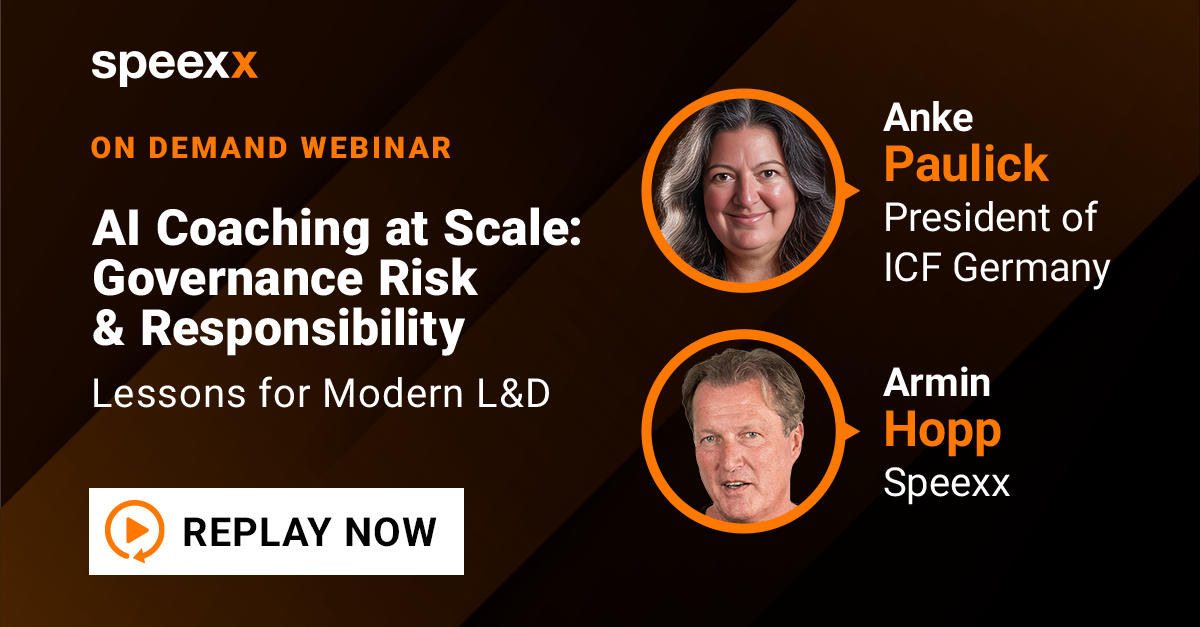
View the full podcast with ICF President Anke Paulick on AI Coaching governance and standards
The ICF view brings opportunity and risk into the same room
Anke did not speak as an AI sceptic. The point from the ICF perspective was sharper than that. AI creates opportunity and responsibility in the same breath. On one side, organizations can widen access to coaching, support reflection between live sessions, and help people practise difficult conversations without waiting for a calendar slot. On the other side, AI coaching introduces bias risk, sensitive data exposure, inappropriate use, and confusion with therapy or advice. The tension is practical, not philosophical.
The research Anke referenced from Nicky H.D. Terblanche helps explain why the opportunity is real. The 2022 paper comparing artificial intelligence and human coaching goal attainment efficacy found that both human coaches and an AI coach were significantly more effective than control groups in helping clients reach goals, and the AI coach was as effective as human coaches at the end of the trials in that narrow goal-attainment context. The same paper is careful about human depth, noting that empathy and emotional intelligence remain areas where human coaches are not replaceable. That is a useful result for L&D leaders because it supports scale while warning against overclaiming. You can read the study on PLOS ONE, and the related Coach Vici research background is also described by Coach Vici.
Anke’s use of this evidence was not a sales argument for AI coaching. It was a quality argument. If a narrower, methodically grounded use case can support goal attainment, the next question is not whether every AI tool is now a coach. The next question is what standards, testing, escalation rules, data protections, and human oversight must surround systems that claim to offer coaching at enterprise scale.
That is where the ICF contribution becomes necessary. The market already uses confident language: AI-augmented, ICF-aligned, scalable, personalized, always available. Some of those claims may be true. Some will be partial. Some will be little more than a friendly interface wrapped around a general-purpose model. HR and L&D leaders need a way to separate evidence from theatre before procurement turns aspiration into implementation.
Guardrails are a buyer issue and a coaching issue
One moment in the conversation felt especially relevant for enterprise buyers. Anke said buyers want guidance because users assume safety the moment they hear the word coaching. That assumption is commercially dangerous and ethically serious. A user who enters a coaching conversation may share doubts about a manager, fears about performance, personal stress, conflict, career anxiety, or emotional strain. The organization may not intend to collect sensitive information, but the system still sits close to sensitive human material.
A responsible buyer therefore needs more than a feature list. The provider needs to explain what the system is designed to do, what it is not designed to do, what happens when a user moves into distress, who sees data, how bias testing works, where human oversight sits, and how coaching methodology informs the product. A good answer will feel operational. A weak answer will rely on reassurance.
The ICF framework helps because it widens the assessment from the interface to the system. It is not enough to ask whether the bot asks pleasant questions. The system includes supporting documentation, functionality, processes, management, security, and technical factors. This is where AI coaching governance becomes visible. The provider has to show how the system works, how it fails, how it learns, and how humans remain accountable.
The European regulatory context is moving in the same direction. The EU AI Act is built around risk, transparency, and trustworthy AI, while the Commission’s guidelines on high-risk AI systems underline the need to classify systems according to context and potential harm. AI coaching will not always fall into the same category as recruitment or performance evaluation, but HR buyers still need a risk view because coaching data and workplace context can be sensitive.

Access without quality is a poor bargain
Enterprise L&D leaders are right to ask for scale. Coaching budgets are finite, the demand for development is growing, and many employees outside the executive population rarely receive structured support. AI coaching can create more coaching cases for the same budget, extend continuity between live sessions, and offer personalization in moments when people need to prepare, rehearse, reflect, or reset. That is a serious opportunity.
The mistake is to frame democratization only as lower cost per conversation. Real democratization means more people get access to useful, safe, methodically grounded development. If a system gives weak advice, blurs the line with therapy, mishandles distress, stores data badly, or reports individual content to managers, it does not democratize coaching. It democratizes risk.
I have become cautious about any AI learning story that treats adoption as proof of value. Usage can be high because the tool is useful, but usage can also be high because the tool is frictionless, entertaining, or emotionally sticky. Marc Zao-Sanders and Sara Biuk’s 2026 How People Are Really Using AI research, developed through AI in the Wild, is helpful here because it shows people using AI in increasingly personal and practical ways. If people already use AI as a thinking partner, HR and L&D leaders cannot pretend formal AI coaching adoption will start from zero.
That reality makes guardrails more urgent. The organization is not introducing AI into a quiet environment. It is introducing a governed coaching system into a workplace where employees may already use public tools for work, decisions, emotions, and preparation. Responsible AI coaching gives people a safer, clearer, professionally bounded alternative. That value depends on trust.
Where Speexx fits in the quality conversation
Enterprise L&D leaders are right to ask for scale. Coaching budgets are finite, the demand for development is growing, and many employees outside the executive population rarely receive structured support. AI coaching can create more coaching cases for the same budget, extend continuity between live sessions, and offer personalization in moments when people need to prepare, rehearse, reflect, or reset. That is a serious opportunity.
The mistake is to frame democratization only as lower cost per conversation. Real democratization means more people get access to useful, safe, methodically grounded development. If a system gives weak advice, blurs the line with therapy, mishandles distress, stores data badly, or reports individual content to managers, it does not democratize coaching. It democratizes risk.
I have become cautious about any AI learning story that treats adoption as proof of value. Usage can be high because the tool is useful, but usage can also be high because the tool is frictionless, entertaining, or emotionally sticky. Marc Zao-Sanders and Sara Biuk’s 2026 How People Are Really Using AI research, developed through AI in the Wild, is helpful here because it shows people using AI in increasingly personal and practical ways. If people already use AI as a thinking partner, HR and L&D leaders cannot pretend formal AI coaching adoption will start from zero.
That reality makes guardrails more urgent. The organization is not introducing AI into a quiet environment. It is introducing a governed coaching system into a workplace where employees may already use public tools for work, decisions, emotions, and preparation. Responsible AI coaching gives people a safer, clearer, professionally bounded alternative. That value depends on trust.
