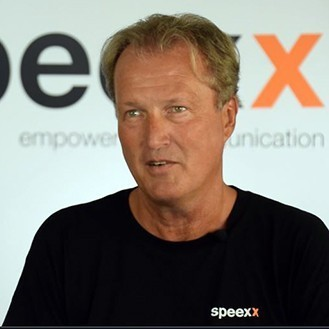
Some people bring answers into an industry discussion. Winfried Felser has a habit of bringing a larger question. That has been true in many of our conversations over the years, and it is one reason he has remained such a persistent connector across the German HR and L&D community through NetSkill, Competence Site and the networks around them.
Our recent work around the skills-based organization followed the same pattern. Together with colleagues from Docebo and 8vance, we had been discussing how companies move from talking about skills to actually using them in learning, talent mobility and people development. We took that discussion to LEARNTEC in May, where the skills-based organization became a very practical conversation about how skills connect with organizational performance.
At Speexx, we were already dealing with a closely related question from another practical angle. Much of people development still operates at the level of individual skills: assess a need, provide an intervention, record progress. We had increasingly been asking what changes when communication is treated as a capability across the enterprise, including how organizations identify what different roles need, provide relevant development across languages and cultures, and understand whether that development is showing up in the work.
Winfried brought Dave Ulrich‘s Human Capability work into this conversation, and it gave the skills debate a much broader frame. Skills tell us something about an individual. Human Capability asks what an organization can actually do through its people and through the systems around them.
That connects directly with the practical problem we had been working on. Developing a skill is one thing, while turning individual capability into something an organization can use consistently across teams, markets and business contexts is a different challenge.
Human Capability is much bigger than a skills framework
Dave’s Human Capability work deserves some care in how we use it. It is easy to take a current HR topic, attach it to an established model and declare a new category. That would miss the point here.
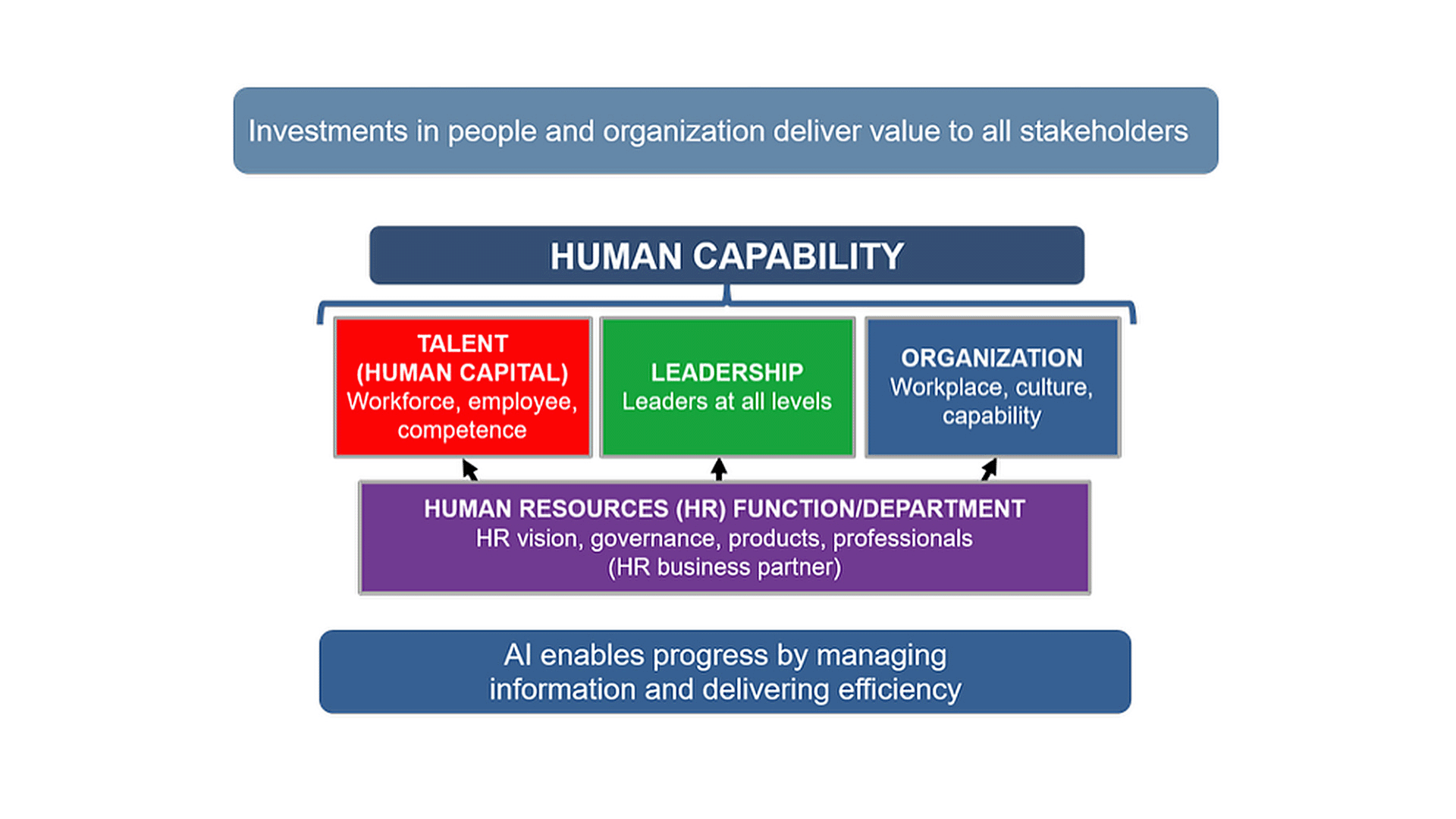
The Human Capability Framework comes from a much longer body of work around how HR creates value from the outside in. Dave Ulrich and Norm Smallwood organize 38 HR initiatives into four pathways: Talent, Leadership, Organization and the HR Function. The point is larger than the taxonomy itself because the framework connects investment across those pathways with the outcomes that matter to employees, customers, investors and other stakeholders.
That makes the model broader than the current discussion about becoming skills-based. Talent includes individual competence and the workforce, but the Human Capability logic deliberately goes further. Leadership considers individual leaders as well as leadership capability across the organization, while Organization addresses the capabilities that allow people to accomplish collectively what individuals cannot accomplish on their own. The HR pathway covers the function, its practices and the people responsible for helping the business build Human Capability.
This distinction is especially relevant to L&D. We have become very good at describing skills at increasing levels of granularity, and skills data can help identify gaps or development priorities. It still does not tell us, on its own, whether the organization can collaborate effectively across boundaries, execute a change in direction or develop the leadership capability its strategy requires.
Dave Ulrich’s research has consistently pushed beyond activity measures toward outcomes. His work also makes a more challenging point for anyone focused mainly on individual development: organization capability can have greater impact on results than talent alone. For those of us in learning and people development, that creates a useful discipline because the business case cannot end with participation or individual skill acquisition.
That emphasis on outcomes is also built into Dave’s work on the Organization Guidance System, developed with Norm Smallwood and Alan Todd. OGS takes the four Human Capability pathways and asks a very practical question: which investments are most likely to contribute to the business outcomes an organization is trying to achieve? It uses assessment and evidence to move beyond benchmarking toward guidance on where to focus investment, and then monitors whether those choices are producing the intended results.
From Talk to Action. Egle Vinauskaite and Don Taylor on practical applications in HR and L&D
The operating question behind Human Capability
My own interest starts one level below that strategic architecture. Once an organization has made choices about the Human Capabilities that matter, those choices still have to become part of everyday work.
At a recent Speexx Roundtable at Zukunft Personal Europe in Cologne, Dominik Habrich, Global Head of People Development at Winkelmann Group, put a useful constraint around that operating question. L&D cannot answer on its own what an organization needs to be able to do next or how it gets there. Once the capability requirement is clear, HR has several routes. Dominik framed them as Build, Buy, Borrow and Bot: develop capability internally, hire it, bring in temporary expertise, or automate work where technology can provide it. Development is one route, not the default answer to every gap.
Dominik’s point becomes more consequential as AI changes both the availability and the shelf life of expertise. Hiring can be faster than building when the capability already exists in the market. In other cases, the knowledge changes so quickly that temporary expertise makes more sense than a long development cycle. Automation adds another option. For L&D, the strategic question shifts from how much learning to provide toward where internal development is the right investment.
His measurement logic follows the same discipline. Effectiveness asks whether the organization can do something it could not do before and actually needs. Efficiency compares the resources used with the alternative routes. Time to capability asks how quickly the organization can move from current capability to required capability. Completion rates and satisfaction still tell us something about the intervention, but they cannot answer those questions.
Take leadership. A company can have a carefully researched leadership model, assessment data and development programs in place. Yet employees experience leadership through daily behavior, including whether a manager can make a decision understandable, handle a difficult conversation, coach someone through a problem or communicate across cultural differences.
That is where coaching becomes relevant when it is connected to the capability required for a role rather than offered as an isolated benefit. Coaching can work on behavior in the context where it matters, while assessment can give the organization a better view of development needs and whether progress is taking place.
The same gap appears in organization capability. A company may decide that better cross-functional collaboration matters to its business, while the operational reality is a project team spread across countries, working in different languages and with different assumptions about how directly people challenge each other or make decisions.
Intercultural development, mentoring and language development can all contribute in that environment. Their value becomes clearer when they are connected to the organizational capability the company is trying to build rather than managed as unrelated programs.
Skills are present in both examples, but skills alone do not describe what is happening. Capability becomes real when people can apply what they know in context and do so consistently enough for it to influence how the organization performs.
This is where I see a role for what I call a Communication Capability Layer. It sits at the operating level and addresses a practical question: how organizations develop and apply the communication capability people need across a large enterprise.
Communication Capability as operating infrastructure
The Human Capability Model provides a strategic framework for identifying where Human Capability investment matters. A Communication Capability Layer provides part of the operational infrastructure through which some of those capabilities can be developed and applied across the enterprise.
That “part of” is deliberate because communication is not the answer to every Human Capability issue. Workforce planning, organization design, reward and HR governance require their own expertise, choices and systems.
A large share of organizational work depends on people working and communicating effectively with other people. Expertise needs to become understandable enough to inform decisions, leadership intent has to survive its journey through the organization, and knowledge often has to cross professional, linguistic or cultural boundaries before anyone can use it.
And this is a territory I know from Speexx. We have spent years working with global organizations where language development, business coaching, mentoring and intercultural programs address different parts of what is often the same enterprise problem: people need communication capability that fits the work they are expected to do. Communication is the part of Human Capability we know best today. It gives us a practical place to start thinking about how capability can be assessed, developed and applied consistently across an enterprise.
The practical opportunity is to connect those development experiences more closely. Assessment can identify where communication requirements differ by role or context, while coaching, mentoring, language development and intercultural programs provide different forms of development depending on the need. At enterprise scale, this cannot operate as a parallel learning environment, so it has to fit into the HR and learning infrastructure companies already use, with AI-powered practice extending access and continuity.
That changes the unit of analysis. Instead of asking whether an employee needs another communication course, an organization can look at the communication capability required for a role or business context, assess where gaps exist and connect development more directly with the work.
From communication skills to Communication Capability
The distinction between a communication skill and communication capability is similar to the distinction that first brought me into the Human Capability discussion. Individual competence remains necessary, but an enterprise has a different problem when that competence has to work across thousands of people and very different business environments.
A person can become more proficient in a language or better at giving feedback. The organizational question begins when a company needs people across different markets to communicate effectively enough for a shared business capability to work.
Consider an international sales organization. Better language proficiency can matter, while the broader capability requirement may include understanding customers across cultures, explaining complex products clearly and adapting communication to different decision-making contexts. Language development and intercultural programs may address parts of that requirement, while coaching can help people work on behavior in higher-stakes customer or leadership situations.
Leadership creates a similar requirement. Development becomes organizationally relevant when managers across the business can communicate in ways that support the leadership expectations of the organization. Business coaching and mentoring can support individual development, while assessment helps connect those interventions with a clearer view of where capability needs exist across the organization.
This is why I have become cautious about treating communication as a broad “soft skills” category. Dave Ulrich’s distinction between individual talent and organization capability gives a broader frame to something we have been seeing in practice: communication matters less as a collection of separate programs than as a capability that has to work across roles and contexts. The relevant evidence is whether that capability is improving how people work, rather than simply whether development activity took place.
AI raises the bar for Human Capability
AI adds another practical reason to make this distinction. It already gives employees easier access to translation, writing support, practice and feedback while changing how knowledge work itself gets done.
Dave has increasingly connected AI with the larger Human Capability agenda rather than treating technology as a separate HR topic. His argument remains anchored in the same logic: new technology becomes useful when it contributes to Human Capability and, through it, to stakeholder value.
For communication, the practical effect is quite specific. AI can help someone produce a polished message, prepare for a coaching conversation or practice communicating in another language. The organization still needs people who understand context, recognize when judgment is required and create enough shared understanding for others to act.
That also changes the measurement problem. Completed content tells us very little about whether communication capability has improved, so enterprises need better evidence connecting role requirements, assessment, development activity and progress. That is consistent with the OGS logic: measurement becomes useful when it helps guide investment and shows whether development is contributing to the outcomes the organization intended.
Dominik has been applying this logic at Winkelmann. The company already had a global talent program with leadership, communication and self-management content that participants valued. The problem was strategic fit. As Winkelmann pushed further into digital manufacturing and faced very different pressures across its businesses, the program was not built around the capabilities the organization now needed most.
The redesign started with a more specific definition of entrepreneurial capability: making decisions under pressure, acting with limited information, delivering results quickly and using digital tools to support the work. The first module moved deliberately from the individual to the team and then to the organization. Participants translated personal development into changes in their own work, while the program also surfaced organizational conditions that could slow the behavior the company wanted.
The stronger test came in the next module. Instead of another conventional training block, participants worked through a Design Sprint on live digitalization challenges supplied by the business. They entered problems outside their usual expertise, changed direction when ideas failed, used AI as part of the work and presented prototypes to the management team. One group developed an assistant for installers around a real service problem. Selected concepts received budget for further development.
That creates a different standard for L&D evidence. The program still develops individuals, but its value is tested against work the organization needs to perform. Participation data becomes secondary to whether people can apply the capability in context and whether the organization changes what it can do as a result.
Putting Human Capability to work
I came into this discussion through skills and through a practical problem we were already working on at Speexx. Dave Ulrich’s Human Capability Model has given me a broader frame for understanding that problem within the larger organization.
The distinction that matters here is between the strategic choices around Human Capability and the operating work required to develop and apply some of those capabilities across an enterprise. Communication belongs in that second discussion, where language development, coaching, mentoring, intercultural development and assessment can be connected around the work people actually need to do.
A Communication Capability Layer gives enterprises a way to treat communication across languages, cultures, roles and regions as a capability they can deliberately develop and assess, rather than as a scattered set of learning interventions. It also connects that development more closely with the work and business contexts where the capability has to perform.
Communication is the part of Human Capability we know best today at Speexx. But the broader direction is clear: over time, the same approach will extend to other capabilities, with organizations becoming more systematic about understanding what a role or business context requires, developing those capabilities in context and connecting the evidence with the systems and work environments where performance happens. That is where I see the longer-term potential for a more comprehensive Human Capability platform.
Dave Ulrich’s work over several decades has pushed the HR conversation from activities toward value and from an emphasis on individual talent toward a broader understanding of Human Capability. For those of us working on the L&D side of that equation, the practical task is more specific: build the development infrastructure that helps relevant capabilities show up reliably in how people actually work.