
Many organizations still use the terms mentoring, coaching, and sponsorship as if they meant the same thing. Yet these three approaches serve very different purposes. Confusing them can lead to poorly defined programs, conflicting expectations and, ultimately, a lower impact on talent development.

For HR and L&D teams, the task is more specific than simply putting support in place. They need to choose the right format for the right need.
Companies are under pressure to accelerate upskilling, strengthen leadership, retain key talent, and support more inclusive career paths. The distinction, therefore, has strategic value. Mentoring works mainly over the long term, coaching focuses on a specific development objective, and sponsorship uses organizational influence to advance a career. Put another way, mentoring provides perspective, coaching drives focused progress, and sponsorship opens doors.
Why distinguishing between the three approaches matters
The distinction is more than just semantics. When roles are unclear, participants don’t know what to expect from the relationship. An employee sent to coaching may expect concrete career advice, while the coach is focused on helping them find their own answers through questioning. A mentoring program presented as coaching can disappoint for the opposite reason: the mentor may share a great deal of experience without a structured framework for objectives or a method for evaluation.
That initial clarity shapes participation, the quality of the experience, and the ability to measure impact.
For HR decision-makers, distinguishing clearly between mentoring, coaching, and sponsorship also helps align investment with business priorities. The same type of relationship will not fit every need. The decision of what approach to select might depend on whether the organization is onboarding new managers, preparing a succession pool, supporting women into leadership positions, or helping a leader through a period of organizational transformation.
The useful question is not “Which approach is best?” It’s “Which one best fits the objective, the employee’s level of maturity, and the company context?”
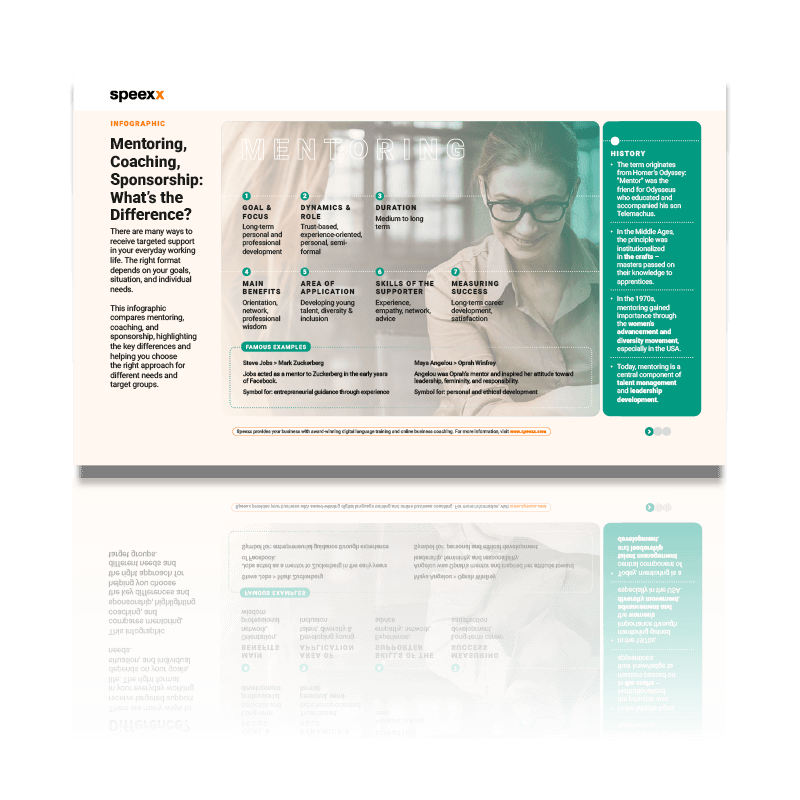
Download our free infographic on mentoring, coaching, and sponsorship, which formed the basis for this article.
Mentoring: sharing experience, providing guidance and supporting long-term growth
Mentoring is a development relationship centered on experience. In general, a more experienced person helps someone else gain perspective, understand how the organization works, build confidence, and broaden their professional outlook. Mentoring is particularly relevant to long-term personal and professional development, with benefits that include guidance, networking, and career advice.
That is what distinguishes mentoring from other forms of development support. A mentor doesn’t focus on correcting short-term performance. Instead, the mentor helps the mentee progress along their career path. Mentoring within organizations is a way of fostering sustainable growth and leadership development, particularly because it supports experience sharing, problem-solving, and decision-making.
Harvard Business School also notes that companies invest heavily in these programs, although their effectiveness depends strongly on how they are designed and experienced by participants.
Mentoring is most useful for:
- onboarding new talent or new managers;
- supporting high-potential employees;
- long-term leadership development;
- diversity, equity and inclusion programs;
- intergenerational knowledge transfer and the sharing of informal organizational know-how.
The main strength of mentoring is depth. Well-designed mentoring goes beyond a series of inspiring meetings. It creates a trusted space where people can discuss decisions, ambitions, mistakes, professional presence, and organizational politics. For HR, it is particularly useful when the aim is to build sustainable career paths and connect learning with day-to-day work.
Coaching: improving performance and accelerating targeted change
Coaching follows a more structured logic. The International Coaching Federation defines coaching as a partnership that engages the client in a thought-provoking and creative process designed to maximize personal and professional potential.
That means a coach is not primarily there to pass on personal experience or provide ready-made answers. The coach helps the coachee clarify objectives, recognize patterns, and change behavior.
In this way, coaching is directly associated with improving performance, developing skills, and changing behavior in a structured, confidential relationship based on partnership. As opposed to mentoring, professional coaching is a way to develop self-awareness, address complex challenges, support leadership, and manage change.
Coaching is most useful for:
- supporting someone as they move into a new role;
- strengthening the leadership of a manager or executive;
- supporting a change in leadership approach or behavior;
- working on communication, feedback, or collaboration;
- helping an employee through a period of transformation or uncertainty.
In an increasingly complex working environment, coaching is valuable because it is highly contextual. Training delivers shared content, while coaching works at the level of the individual, their real challenges, and their environment.
For L&D leaders, this makes coaching a strong complement to digital development. A platform provides continuity and scalability; coaching adds personalization, action, and deeper reflection. This combination of digital and human support reflects the current need for operational efficiency alongside individual development.
Sponsorship: when influence becomes a career development tool
Sponsorship is often less well understood, yet it can be decisive for career progression. Unlike a mentor, a sponsor does more than advise. A sponsor actively advocates for someone, recommends them, raises their visibility, supports their access to opportunities, and helps them secure assignments or roles that matter.
McKinsey captures the distinction clearly: sponsorship goes further than mentoring because it involves opening doors and using a network to create concrete opportunities, rather than providing guidance alone.
This Speexx infographic reinforces the point: sponsorship is aimed at career progression, visibility, and promotion, with access to opportunities and decision-makers among its main advantages. Harvard Business Review has also shown that a lack of powerful sponsors can restrict women’s access to leadership positions, in part because high-visibility assignments and career-advancing roles are not distributed neutrally.
Sponsorship is therefore particularly relevant for advancing high-potential talent, especially within leadership and inclusion initiatives.
Sponsorship is most useful for:
- accelerating the progression of key talent;
- increasing the visibility of high-potential employees;
- supporting women and people from underrepresented groups in their career progression;
- preparing management succession;
- connecting talent more quickly with decision-makers and strategic projects.
Sponsorship is often the missing link in HR policy. Many organizations know how to create mentoring programs. Fewer structure sponsorship in a deliberate way, even though it directly affects mobility, recognition, and access to informal influence.
Mentoring vs coaching vs sponsorship: how to choose the right approach
HR teams can start with three practical questions.
1. What is the main objective?
If the objective is professional growth, perspective, and the transfer of experience, mentoring is generally the best fit. If the need is targeted progress, a change in behavior, or improved performance, coaching will often be more appropriate. If the objective is to accelerate a career or connect talent with visible opportunities, sponsorship is the system to set up.
2. What is the employee’s level of maturity?
An employee at an early or mid-career stage will often benefit from a mentor who can help them read the organizational environment, build confidence, and broaden their frame of reference. A manager already in that role who faces a specific challenge is more likely to benefit from coaching. Recognized talent ready for faster progression will often need a sponsor who can raise their visibility at the right level.
3. What evidence of impact are you looking for?
Mentoring is generally measured over time through engagement, satisfaction, progression, retention, confidence, and a sense of belonging. Coaching lends itself more readily to indicators linked to goal attainment, feedback, and behavioral change. Sponsorship is often visible through promotions, increased visibility, access to strategic assignments, or a broader network of influence.
Think in terms of an ecosystem, not separate programs
In practice, mature organizations do not treat these approaches as competing alternatives. They combine them. Someone can work with a mentor to gain perspective, use coaching during a management transition, and receive sponsorship at a key point in their career. An ecosystem approach can address individual development needs while supporting the company’s strategic priorities.
For HR and L&D teams, the task is to design development journeys flexible enough to connect digital tools, human support, and business objectives. Mentoring, coaching, and sponsorship serve different purposes, but they can complement one another. When the roles are clearly defined, the relationships are properly structured, and the programs sit within a coherent talent development strategy, they can support learning, leadership development, and internal mobility.
Choosing the right approach at the right time
Mentoring supports long-term growth. Coaching supports focused progress. Sponsorship helps people move into opportunities that can change the direction of a career. For organizations, the task is not to follow the latest development trend, but to put the right structure in place at the right time. That is when development support can contribute to sustainable performance, engagement, and fairer access to career opportunities.